The English Student
  • Home
  • Blog
  • Illustrations
  • About
  • Say Hello

Do You Like Broccoli Ice Cream?

2/18/2014

0 Comments

 
Sometimes the best way to learn a language is through songs. But have you tried songs  for children? It's much simpler and you can really learn a lot of everyday conversational phrases and improve your pronunciation. When you sing the song, you also remember phrases faster than memorization.

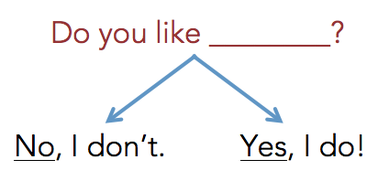
Today practice and become familiar with asking "do you like" questions and its responses. Ask someone if they like broccoli ice cream!
Picture
0 Comments

When To Use A and An

2/17/2014

3 Comments

 
Since last year, I wanted to make an effort to eat healthier. I researched and collected a lot of recipes. Then I started to make them one by one. The problem was, every time I made a dish, I would forget the recipe the next time I made it. I would have to go back and look at the recipe again every time. But there was one particular dish I loved, a Korean dish which I probably made once a week and because I made it so frequently, I now no longer need to look at the recipe. This is the same with learning English. The more practice, the more you'll remember and soon it will be so natural that you no longer need to stop and think!

A lot of students have trouble remembering the difference between 'a' and 'an.' These are known in English grammar as ARTICLES. They tell us something about a noun. Articles are very common in English and if you don't really speak or write enough in English, it's easy to forget these things even if it's something used so frequently.

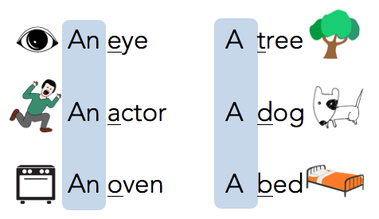
First look at how  'a' and 'an' are used
below.
The English Student, English Student blog, ESL blog, fun ESl sites, ESl blog, English grammar, difference between a and an, English articles, indefinite articles, definite articles, singular, plural
What do you notice about the nouns used (underlined)? Are the nouns describing one thing or more than one? If I say, "I have an oven" or "I have a dog" it usually means I have just one. So both 'a' and 'an' are used with singular nouns (one tree, one eye, one bed).

When we use 'a' and 'an,' they both also describe an unspecific noun. When we say 'a dog' we are talking about any dog, not one specific or particular dog. (To refer to a specific dog we must use 'the' instead of 'a' but I will talk more about this later this week).

Then what's the difference between the two?
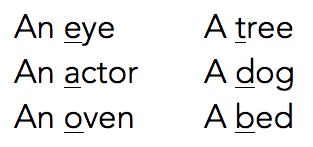
Using the same example, take a look at the underlined letters below.
Picture
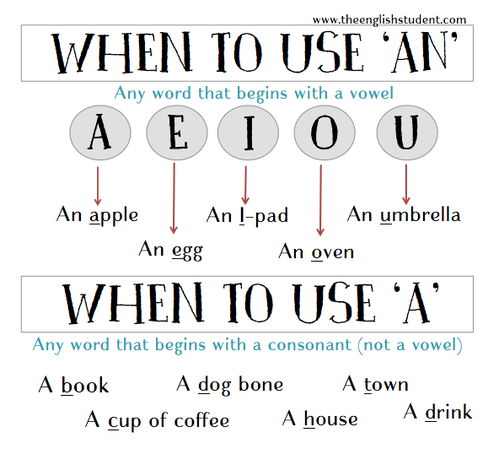
Do you notice anything with the first letter of the left column (e,a,o)? They are all part of the English vowel! A, E, I, O, U ! So we use 'an' with singular nouns that start with a vowel. Now you probably know when we use 'a'- with singular nouns that does not start with a vowel (anything that is not A,E,I,O,U). 
The English Student, English Student, English student blog, ESL blog, fun ESL sites, ESL tutor, difference between a and an, when to use a and an, english grammar, indefinite articles, definite articles, singular, plural
The general rule is:
Both 'a' and 'an' are used with singular nouns (a car, a burger, a phone)
If the word begins with a vowel (A,E,I,O, U) then we use 'an'
If the word begins with a letter that is NOT a vowel then we use 'a'

There are a few exceptions however!
If a letter makes a sound like sounds like it's a vowel then we use 'an'
For example, 'hour' and  ' honest' (even though the 'h' is not a vowel but the letter sounds like a 'o' in this word)

If a letter makes a sound like a consonant then we use 'a'
For example, 'user' and  'university' (even though the 'u' is a vowel but it sounds like 'y'
)

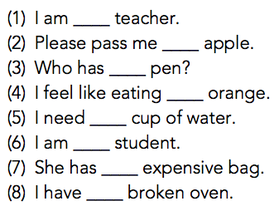
Do some practice!
Picture
Answers:
(1) a  (2) an  (3) a  (4) an  (5) a (6) a  (7) an  (8) a
Print Friendly and PDF
3 Comments

The Most Romantic Movie 

2/13/2014

0 Comments

 
Do you watch a lot of romantic love movies? Do you have a favorite one?  
The English Student, English student blog, ESL blog, fun ESL sites, ESl websites, most romantic movies, valentine's day, ESL movies, learn English online, ESL ideas
I love the movie, "You've Got Mail, it's sweet, funny, and has two of my favorite actors. But I don't think I would choose it as the most romantic movie of all time.

Do you know what  the phrase, "OF ALL TIME" means? If you think it has something to do with time then you're right!

It means the best throughout the ages, of all possible time. So if we say the movie Pretty Woman is the most romantic movie of all time, it means it's the most romantic in this lifetime, no other movie could ever compete with it and win this title.

It might help if you try to substitute the phrase "OF ALL TIME" with the word "EVER"

He's on of the greatest actors of all time (EVER)
Whitney Houston had the greatest voice
of all time (EVER)
What's the most romantic movie of all time (EVER) ?

Can you make up your own sentence with this phrase?
0 Comments

Ideal Valentine's Gift

2/13/2014

0 Comments

 
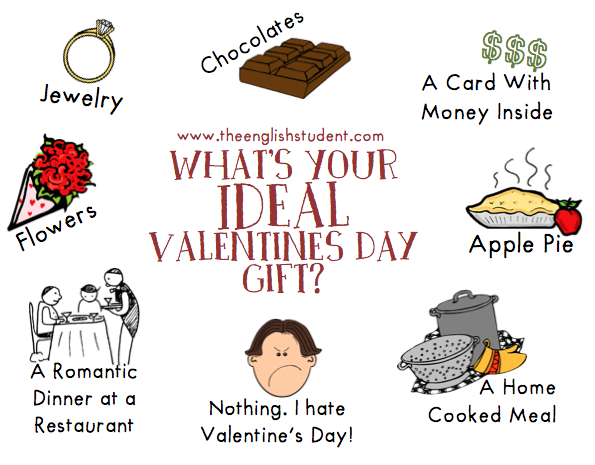
Valentine's Day is tomorrow. This is a time where couples, married or unmarried, show one another how much they love each other. They may go out and celebrate, have a romantic meal at home or exchange special gifts. It's also a time to show your love and affection to friends and family members by giving each other cards, flowers, candies etc.

But for some people, like my husband, Valentine's Day is a pointless holiday. To him, there are just too many expectations for a man- what to buy, what to cook, what to wear. On top of that, he thinks we shouldn't only be reminded to show our love on Valentine's Day, it should be everyday! I have to agree with him on this one.

So what are you planning on doing this Valentine's Day and what is your ideal gift? I know I wouldn't mind a card with some money inside ;-)
The English Student, English Student, English Student blog, ESL tutor Seattle, ESL tutor, ESL website, ESL blog, What is Valentine's Day, ESL culture, Valentine's Day, fun ESL sites,
0 Comments

Do You Believe In Love At First Sight?

2/11/2014

0 Comments

 
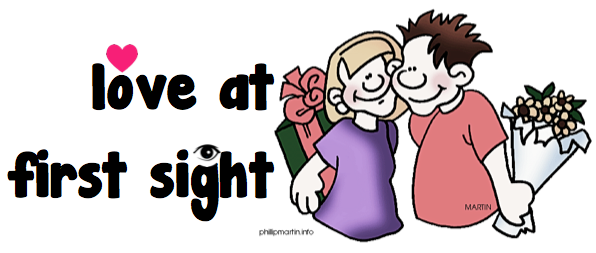
Do you know what it means to love someone at "first sight?"

You've probably seen it a lot in romantic movies where a woman accidentally spills her coffee on a man, he looks up, they see each other for the first time, then there are fireworks! They both know there is a powerful mutual attraction. He thinks she's "the one!"

You will also hear this from a lot of parents meeting their newborn baby for the first time, "when I saw my baby girl I knew it was love at first sight!"

The word "sight" means something that is seen, so to love at first sight means to love someone the first time you see them.

Do you believe in love at first sight? Have you ever had this connection with someone?
The English Student, English Student, English student blog, ESL blog, fun ESL sites, love at first sight, what does love at first sight mean, English phrases, teaching ESL
0 Comments

Speak Faster!

2/11/2014

0 Comments

 
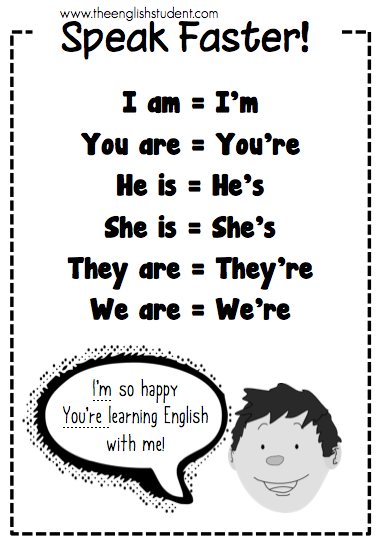
Contractions are words that are created by combining two words into one word to make speech easier. One of the two words is usually a helping verb or also known as auxiliary verb. When we put the two words together, one or more letters are removed and replaced by an apostrophe as you can see below.
Picture
In the first example (I AM ), the  "I " is the subject and "AM" is the verb. We combine these two words by replacing the "A" in "AM" to an apostrophe. This is the same as the rest of the examples. We take out the first letter of the second word and replace it with an apostrophe.

These words are very common in informal conversations and writing. Being able to speak these contracted forms makes your speech more natural and can also make you sound more like a native speaker! There are many many more contractions (CAN'T, WOULDN'T, COULD'VE, THERE'S) but that is for some other time!

Try changing the two words in each sentence into one:
1.    He is from Argentina. _____________________________________________________________ 
2.   You are my hero. _________________________________________________________________ 
3.   You are not a student. ___________________________________________________________  
5.   They are my children. ____________________________________________________________  
6.   She is not hungry. ________________________________________________________________  
7.    I am thirsty. ______________________________________________________________________  
8.   We are almost home. ____________________________________________________________ 
9.   They are going to dinner. _________________________________________________________


Important thing to remember!

They are = They're ≠ Their
(They are is the same as they're but it does not have the same meaning as their)

You are = You're ≠ Your
(You are is the same as you're but it does not have the same meaning as your)
0 Comments
<<Previous
Forward>>
    Picture
    Picture


    ARCHIVE

    January 2017
    December 2016
    August 2016
    July 2016
    June 2016
    May 2016
    April 2016
    March 2016
    January 2016
    December 2015
    November 2015
    October 2015
    September 2015
    August 2015
    July 2015
    June 2015
    May 2015
    April 2015
    March 2015
    February 2015
    January 2015
    December 2014
    November 2014
    October 2014
    September 2014
    August 2014
    July 2014
    June 2014
    May 2014
    April 2014
    March 2014
    February 2014
    January 2014
    December 2013
    November 2013
    October 2013


    CATEGORIES

    All
    Business English
    Comprehension
    Cooking
    Culture
    Grammar
    Idioms
    Life Improvement
    Listening
    Pronunciation
    Punctuations
    Slang
    Vocabulary


    Teaching Blog Addict

    BlogWithIntegrity.com

    DMCA.com Protection Status
    Protected by Copyscape Web Plagiarism Software
    Creative Commons License
    This work is licensed under a Creative Commons Attribution-NonCommercial-NoDerivatives 4.0 International License.

    RSS Feed

THE SITE

Home
About
Blog
Illustrations

SHOP

Teachers Pay Teachers

SUPPORT

Contact
FAQ
Customer Care
Terms of Use

LET'S KEEP IN TOUCH

Picture
  • Home
  • Blog
  • Illustrations
  • About
  • Say Hello